
Church Heritage
Fraserburgh & District Parish Church was formed in July 2024 through the union of seven congregations, each with its own unique history, traditions and faithful witness. Together, these churches have served their communities for centuries, sharing the Christian faith across Fraserburgh and the surrounding villages.
Explore the story of each congregation below, from the founding of Fraserburgh Old in 1571 to the formation of our united parish in 2024.
- 1571 – Fraserburgh Old Parish Church
- 1870 – Rathen West Church
- 1876 – Fraserburgh West Church
- 1878 – Fraserburgh South Church
- 1882 – Pitsligo Parish Church (Rosehearty)
- 1882 – Sandhaven Parish Church
- 1930 – Inverallochy & Rathen East Parish Church
- 2024 – Fraserburgh & District Parish Church
Fraserburgh Old Parish Church
Fraserburgh Old Parish Church
A Church at the Heart of Fraserburgh
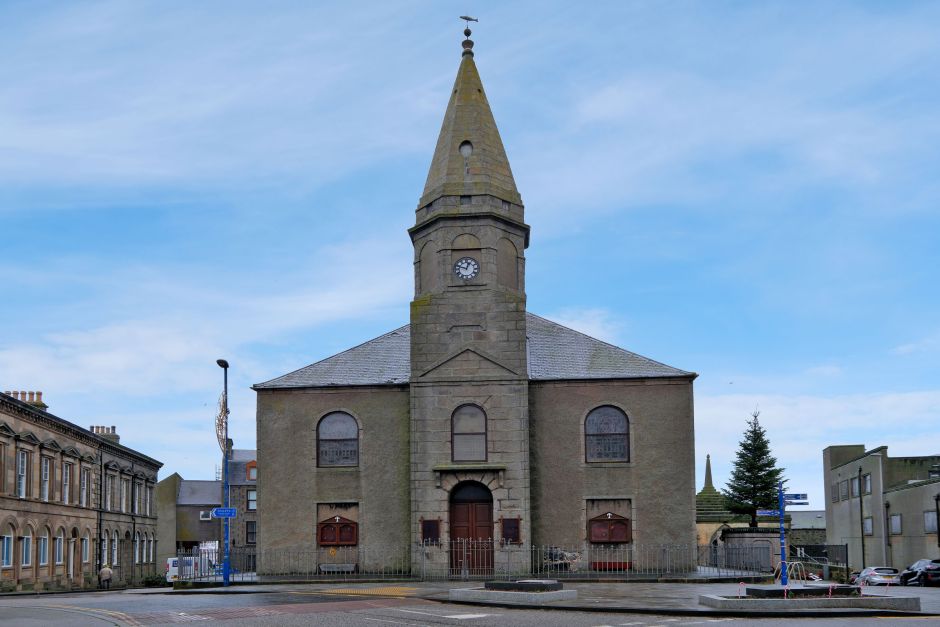
Fraserburgh Old Parish Church has occupied a central place in the religious and civic history of Fraserburgh for more than four centuries. Established in 1571, when the settlement was still known as Faithlie, the church was among the earliest buildings created as Sir Alexander Fraser developed the area into the town that would become Fraserburgh. A place of Christian worship has remained on the site ever since.
For generations, the Old Parish Church served as Fraserburgh’s historic parish kirk. Within its walls, local people gathered for worship and prayer and marked some of the most important occasions in family and community life. Baptisms, marriages, funerals, remembrance services and civic occasions all formed part of the church’s long ministry to the town.
The First Church at Faithlie
The original church was constructed in 1571, shortly after the Scottish Reformation and during the early development of Fraserburgh. It stood close to Kinnaird Head and the growing settlement planned by Sir Alexander Fraser. The early building was enlarged around 1628 and repaired in 1698 before eventually being replaced at the beginning of the nineteenth century. Some elements associated with the earlier church appear to have survived within or beside the present building.
The early history of the congregation reflects the wider religious changes taking place across Scotland. During the late sixteenth and seventeenth centuries, the governance of the Scottish Church moved between Presbyterian and Episcopal forms. Fraserburgh’s parish church experienced these national disputes at a local level as ministers and parishioners responded to changes imposed by the Crown and the Church.
One of the best-known early ministers was the Rev. Charles Ferme, who was appointed to Fraserburgh near the end of the sixteenth century. Ferme was also the first Principal of the short-lived University of Fraserburgh, creating an important link between the parish church and the town’s early educational ambitions.
Ferme was a committed Presbyterian at a time when King James VI was attempting to strengthen Episcopal government within the Scottish Church. His participation in the unauthorised General Assembly held at Aberdeen in 1605 led to his imprisonment, first at Doune Castle and later on the Isle of Bute. He eventually returned to his parish and continued as minister until his death in 1617.
Following the restoration of Presbyterianism as Scotland’s established form of church government, Fraserburgh again experienced tension. In the early eighteenth century, disagreements arose over the appointment of a Presbyterian minister, reflecting the strength of continuing Episcopal sympathies within the area. Presbyterian ministry was firmly re-established in the parish in 1707 under the Rev. Alexander Auchinleck.
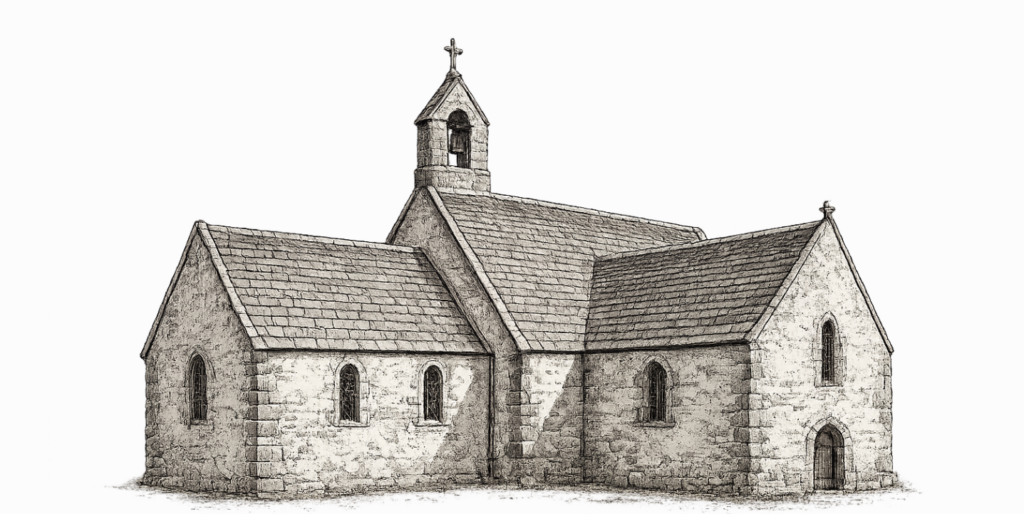
Note: This is an AI Generated image of the Original Auld Kirk, this has been created using the description of what we know about the original building.
The Present Church Building
By the end of the eighteenth century, the original building was no longer adequate for the needs of the parish. The present church was therefore constructed in 1803 on the site of the sixteenth-century kirk. Designed by Alexander Morrice, it is a rectangular Georgian church with a harled exterior, ashlar margins and a slated roof. Its western frontage is distinguished by a granite tower with an octagonal upper stage and spire. A date stone beneath the tower records the year 1803.
The building was later altered and remodelled, particularly towards the end of the nineteenth century. A chancel was added in the 1890s, extending into the nave and creating the general arrangement familiar to later generations of worshippers. The church is recognised as a Category B listed building, reflecting its architectural and historical importance.
On the south side of the church stands the historic Saltoun Mausoleum. This small stone structure is believed to incorporate part of the earlier church and may originally have served as a chapel or aisle with a burial vault for the Fraser family, Lords Saltoun. Its stone pyramidal roof, heraldic panel and association with the founding family of Fraserburgh make it an important surviving feature of the site.
The Douglas Strachan Window
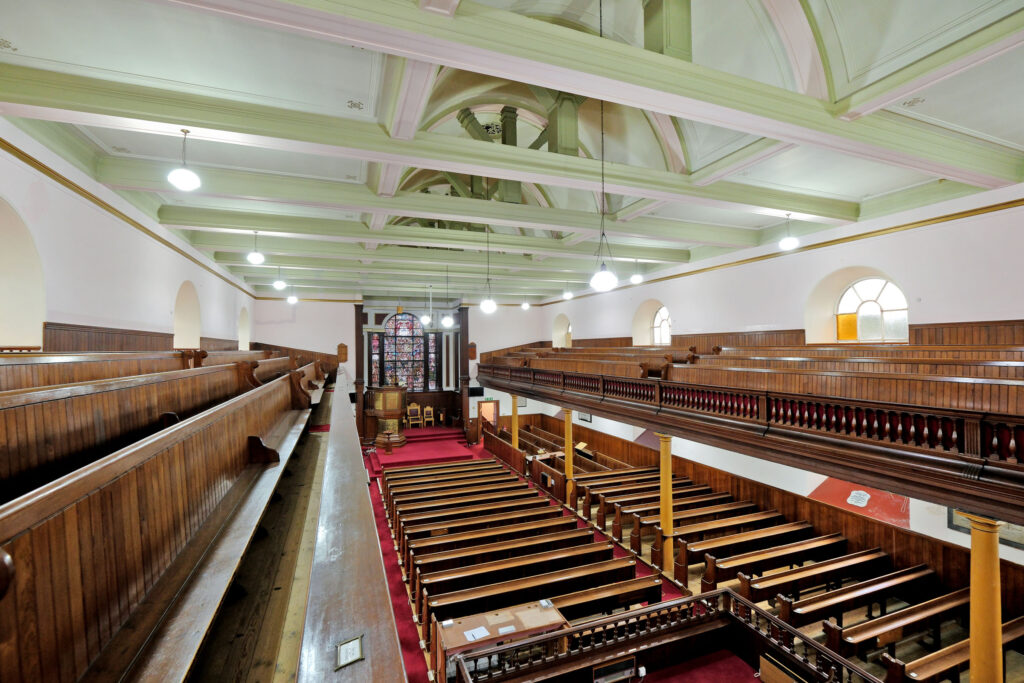
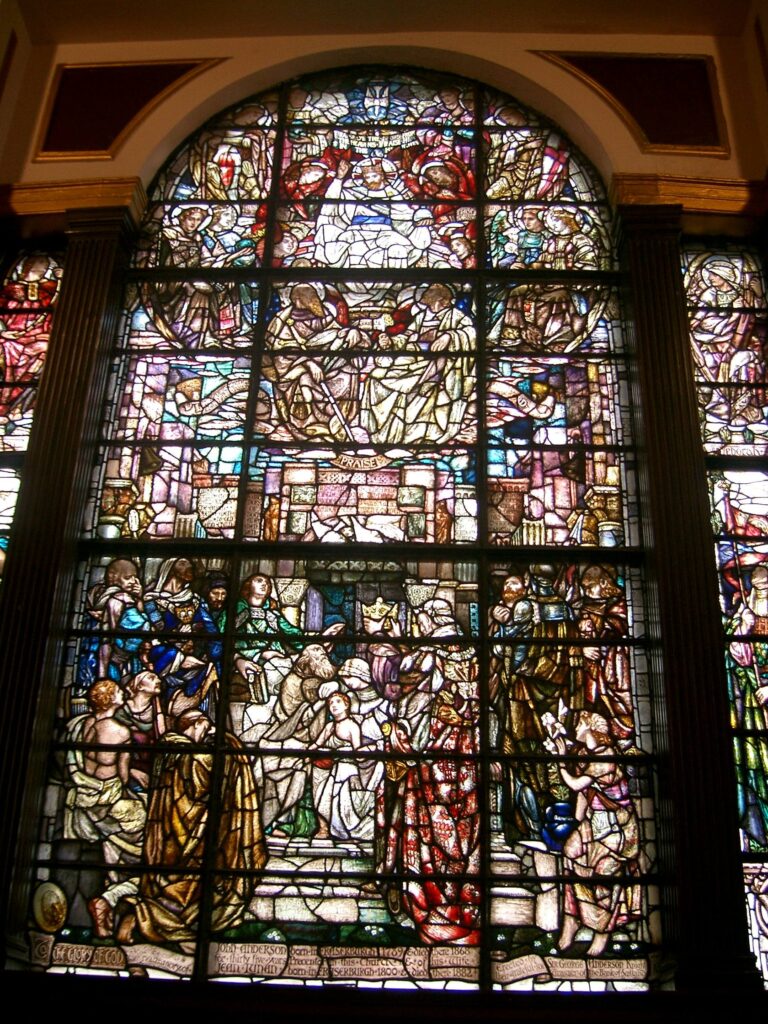
One of the church’s finest features is the great stained-glass window in the chancel. Created by the renowned Scottish artist Douglas Strachan, it was installed in 1906 and gifted by Sir George Anderson, Treasurer of the Bank of Scotland, in memory of his parents. It is regarded as one of Strachan’s notable early works.
The window takes its inspiration from Psalm 148, in which all creation is called to praise God. Its lower section portrays people of different ages and positions in life offering worship, while the upper portion depicts Christ surrounded by the heavenly host. Figures including St Peter, St Paul, Miriam and Deborah connect the worship of the Church on earth with the praise of heaven. Symbols including doves and lilies represent peace and purity.
The window was repaired and restored in 2012, preserving it as one of the most significant artistic treasures associated with the Old Parish Church.
The Pulpit and the World Wars
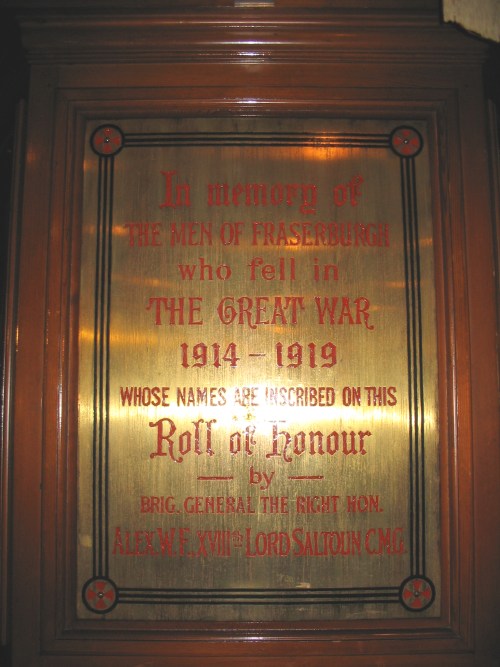
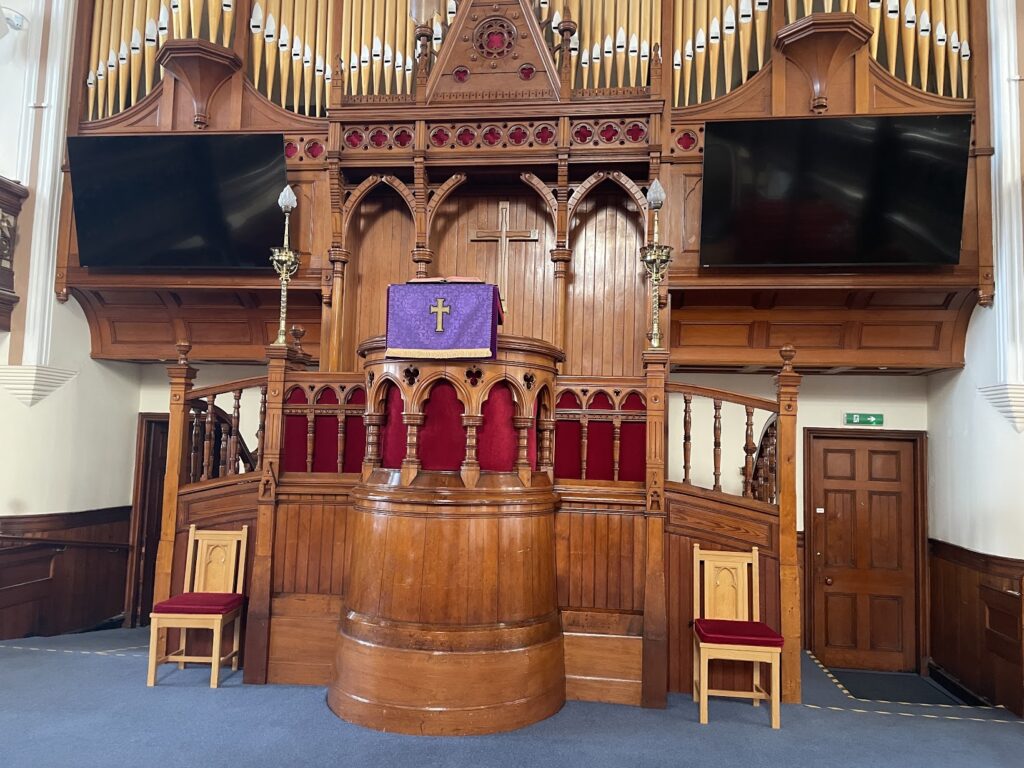
The imposing wooden pulpit is believed to be one of the highest in Scotland. It also serves as the congregation’s memorial to those who lost their lives during the First World War. Six brass panels attached to the pulpit record the names of men from the parish who died in the conflict.
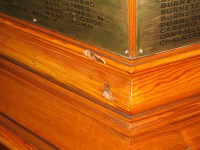
The church also carries a physical reminder of the Second World War. During an air raid, a bomb struck a nearby public house and debris crashed through the church roof. A scar left at the base of the pulpit became known affectionately within the congregation as “Hitler’s Mark.” The roof was repaired, but the mark was retained as a reminder of the danger experienced by the town during the war.
The names of local people who died during the Second World War are commemorated on the town’s war memorial near Saltoun Place and Strichen Road. Remembrance remained an important part of the church calendar, with the congregation joining the wider community in honouring those who served and died.
The Wreck of the Veteran
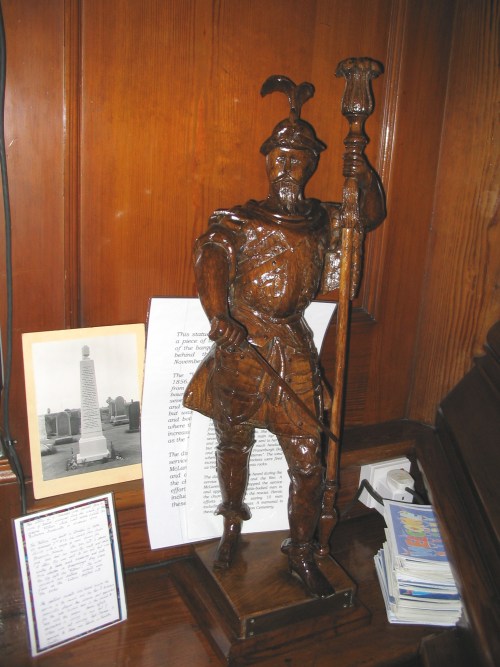
Another unusual feature associated with the church is a small wooden figure carved from timber recovered from the wreck of the barque Veteran. The vessel was driven ashore near Fraserburgh’s Balaclava Breakwater during a severe gale in November 1874.
Distress rockets from the ship were reportedly heard while worship was taking place in the church. The minister, the Rev. A. McLaren, stopped the service and appealed for able-bodied men in the congregation to assist with the rescue. Their efforts helped save ten members of the crew, including the captain. The carved figure preserved within the church became a reminder of the close relationship between the congregation, the harbour and Fraserburgh’s seafaring community.
The Church Organ
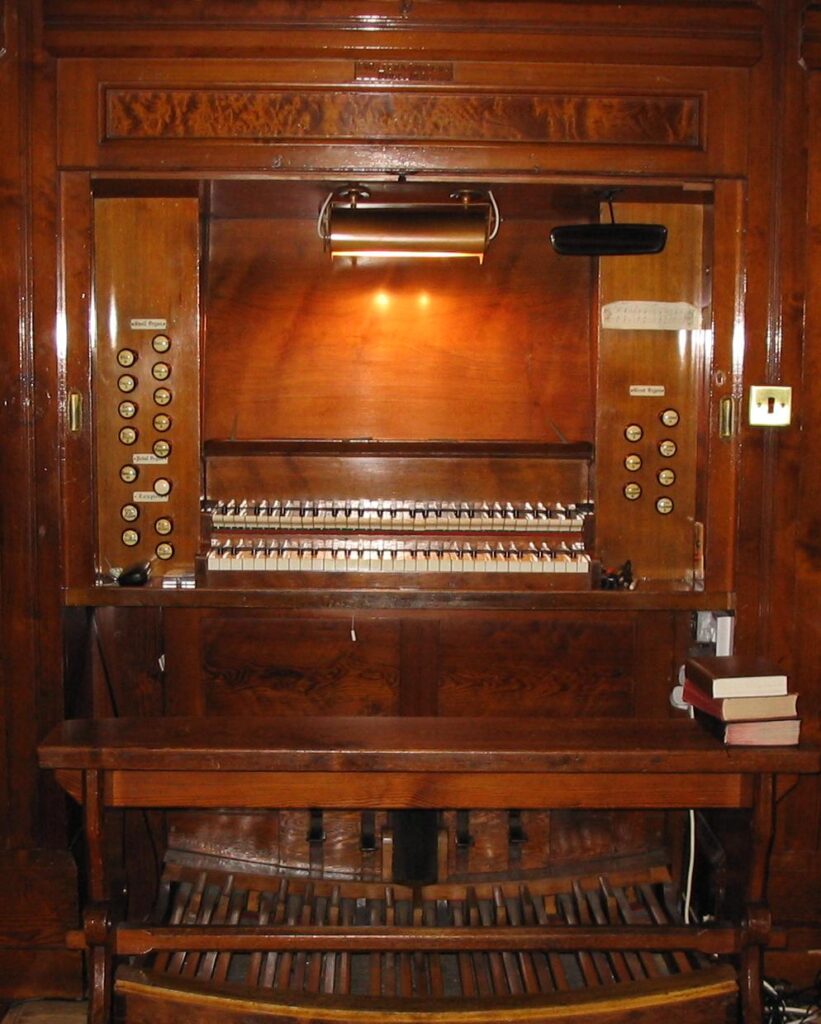
The pipe organ was installed in 1892 by the respected organ builders Forster and Andrews of Hull. It is an unaltered two-manual instrument and remained an important part of worship, accompanying generations of congregational singing, choirs, special services and musical events.
The presence of the organ reflects the changes made to the church during the late nineteenth century, when the interior was extensively remodelled and enriched with many of the features now most closely associated with the building.
Marconi and Other Visitors
Among the most famous people associated with Fraserburgh Old Parish Church is Guglielmo Marconi, the pioneer of wireless telegraphy. Marconi spent time in Fraserburgh while conducting early wireless experiments in the area and is understood to have attended worship at the Old Parish Church. A front pew in the south gallery was marked as the place where he sat.
The church also welcomed other notable visitors during its long history, including members of the Royal Family and representatives of civic, charitable and maritime organisations. These visits reflected the church’s prominent place within the life of Fraserburgh.
Worship and Community Life
Although the historic building is one of Fraserburgh Old’s most visible legacies, the life of the congregation extended far beyond Sunday worship. Over the years, the church supported Sunday schools, Bible classes, choirs, fellowship organisations, youth groups and activities for people of all ages.
Organisations associated with the congregation included the Boys’ Brigade, Girls’ Brigade, Covenanters, badminton groups, junior choirs and Sunday School classes. Through these organisations, generations of children and young people learned about the Christian faith, developed friendships and participated in the wider life of the church.
The congregation also provided pastoral care during times of illness, bereavement and hardship. Ministers, elders, volunteers and members served the people of Fraserburgh through changing social and economic conditions, including the growth of the fishing industry, two World Wars and the continuing development of the town.
A former school building, known locally as the Penny Schoolie, was acquired for use as a church hall and later renovated. A new church centre was constructed between 1990 and 1992, providing improved accommodation for organisations, meetings and community activities.
A Shared Heritage
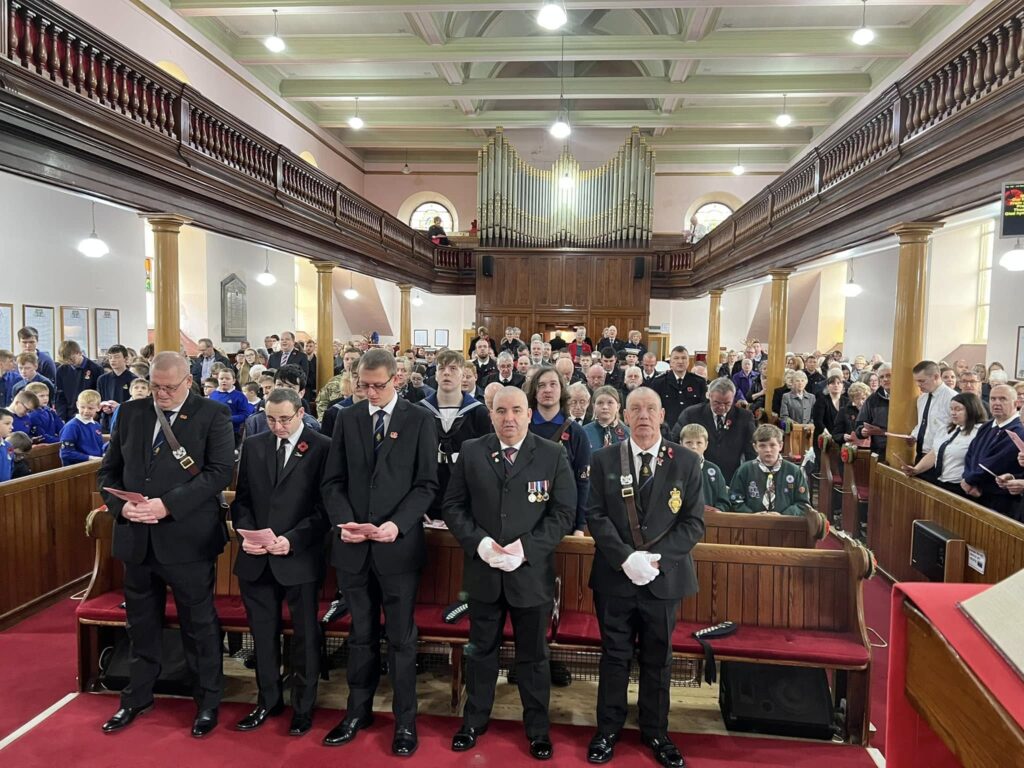
In July 2024, Fraserburgh Old became one of the seven congregations united to form Fraserburgh & District Parish Church of Scotland. The union brought together Fraserburgh Old, Fraserburgh South, Fraserburgh West, Rathen West, Inverallochy & Rathen East, Pitsligo and Sandhaven as one parish serving Fraserburgh and the surrounding communities.
The history of Fraserburgh Old remains an important part of the identity of the united congregation. Its story spans the establishment of Fraserburgh itself, the religious struggles of post-Reformation Scotland, the growth of the fishing town, the hardships of war and many generations of Christian worship and service.
The historic church building, its memorials and its surviving furnishings provide a visible connection with that long history. More importantly, the faith and service of the people who formed the congregation continue through the life and mission of Fraserburgh & District Parish Church.
Key Dates
1571 – The original parish church was built in the settlement then known as Faithlie.
1599 – The Rev. Charles Ferme became minister and was closely associated with the University of Fraserburgh.
1605 – Ferme attended the unauthorised General Assembly of Aberdeen and was subsequently imprisoned.
1628 – The original church was enlarged around this period.
1698 – Repairs were carried out to the early church building.
1707 – Presbyterian ministry was firmly re-established under the Rev. Alexander Auchinleck.
1803 – The present church building was completed to a design by Alexander Morrice.
1874 – The barque Veteran was wrecked near Fraserburgh, leading to a rescue involving members of the congregation.
1892 – The Forster and Andrews pipe organ was installed.
1898 – Major internal remodelling of the church was undertaken.
1906 – The Douglas Strachan stained-glass window was installed.
1914–1919 – The pulpit became a memorial to members of the parish who died in the First World War.
1990–1992 – A new church centre was constructed.
2012 – The Douglas Strachan window was repaired and restored.
July 2024 – Fraserburgh Old united with six neighbouring congregations to form Fraserburgh & District Parish Church of Scotland.
Rathen West
Rathen West Church
A Rural Church with Ancient Roots
Rathen West Church has served the rural communities of Rathen and the surrounding countryside for generations. Although the present church building dates from 1870, the Christian heritage of the Parish of Rathen stretches back to medieval times, making it one of the oldest ecclesiastical parishes in the Buchan area.
For centuries, the church has been a place of worship, fellowship and pastoral care for farming families and village communities. While the congregation was smaller than some of the churches within Fraserburgh, its faithful witness and close-knit community have formed an important part of the area’s Christian life.
The Ancient Parish of Rathen
The Parish of Rathen has existed since at least the medieval period and is believed to have been established many centuries before the Scottish Reformation of 1560. The parish originally centred on the historic Rathen Kirk, which served the local population for hundreds of years.
Following the Reformation, Rathen continued as an established parish within the Church of Scotland. Like many rural congregations, it experienced periods of growth, change and challenge as the population and pattern of village life evolved over the centuries.
The Present Church
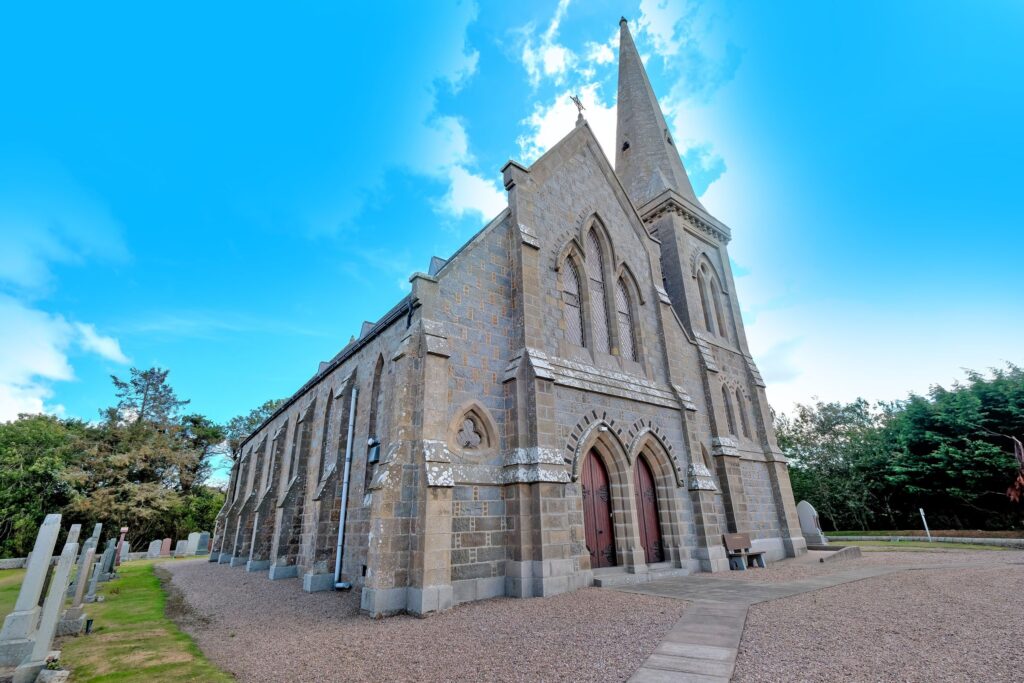
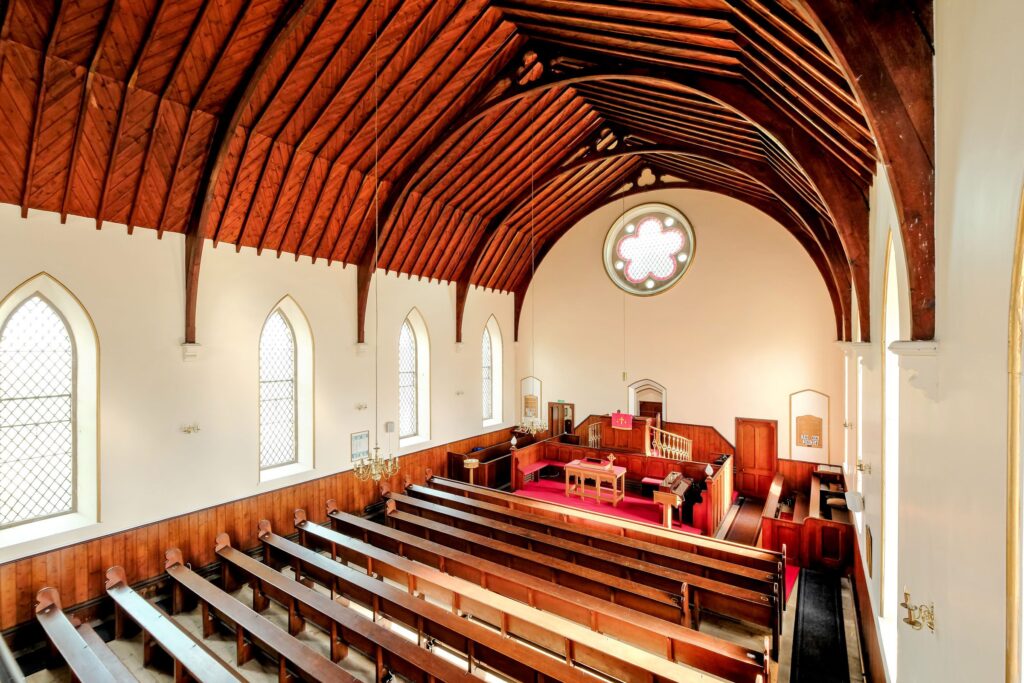
By the nineteenth century, the older church building was no longer suitable for the needs of the congregation. The present Rathen West Church was completed in 1870, providing a bright and practical place of worship for the parish.
Constructed in a simple Gothic style typical of rural Victorian churches, the building reflects the character of the surrounding countryside. While modest in size, it became the spiritual home for generations of local families, hosting weekly worship, baptisms, weddings, funerals and community gatherings.
Its peaceful rural setting has long made Rathen West a distinctive place of worship within the Buchan landscape.
Worship and Community Life
Throughout its history, Rathen West Church has played an important role in the life of the local community. Worship services brought together families from farms and nearby villages, while church events provided opportunities for fellowship throughout the year.
The congregation supported Sunday School, seasonal services, harvest thanksgiving, remembrance services and community events. As with many rural churches, the building became much more than simply a place of worship—it served as a focal point for community life.
Generations of ministers, elders and volunteers faithfully cared for the congregation, offering pastoral support during times of joy and sadness alike.
Partnership with Fraserburgh West
In the early twenty-first century, changing demographics and declining congregational numbers led to closer cooperation with neighbouring congregations. Rathen West entered a linked charge with Fraserburgh West Church, sharing ministry while continuing to worship within its own building.
This partnership strengthened relationships between the two congregations and reflected the wider changes taking place across the Church of Scotland as it adapted to serve communities in new ways.
A Shared Future
In July 2024, Rathen West Church became one of the seven congregations that united to form Fraserburgh & District Parish Church of Scotland, alongside Fraserburgh Old, Fraserburgh South, Fraserburgh West, Inverallochy & Rathen East, Pitsligo and Sandhaven.
Although the congregation is now part of a larger parish, the history and witness of Rathen West continue to form an important part of the united church. Its rural heritage, faithful congregation and centuries of Christian worship remain an enduring legacy within Fraserburgh & District Parish Church.
Key Dates
Medieval Period – The ancient Parish of Rathen was established.
1560 – The Scottish Reformation brought the parish into the reformed Church of Scotland.
1870 – The present Rathen West Church building was completed.
2002 – Rathen West entered a linked charge with Fraserburgh West Church.
July 2024 – Rathen West united with six neighbouring congregations to form Fraserburgh & District Parish Church of Scotland.
Fraserburgh West Church
Fraserburgh West Church
A Church for a Growing Town
Fraserburgh West Church was established in 1876 to serve the rapidly expanding western districts of Fraserburgh during the town’s Victorian growth. As new housing spread beyond the historic centre, the Church of Scotland recognised the need for a new place of worship to meet the spiritual needs of the growing population.
For almost 150 years, Fraserburgh West Church faithfully served its congregation through worship, pastoral care and community outreach. It became known not only for its distinctive church building but also for its vibrant organisations and strong commitment to serving the wider community.
The Foundation of Fraserburgh West
During the nineteenth century, Fraserburgh experienced significant expansion as the fishing industry prospered and the town’s population increased. Much of this development took place to the west of the original parish church, creating the need for a new congregation.
Construction of Fraserburgh West Church began in 1875, and the church was officially opened in September 1876. The first minister was the Rev. Thomas Rogers B.A., who came to Fraserburgh from Ireland. A nucleus of the new congregation was formed by members transferring from Fraserburgh Old Parish Church, allowing the new church to establish itself quickly within the growing town.
The new church became the centre of the newly created West Church parish, serving one of Fraserburgh’s fastest-growing residential areas. By 1877, the West Church had been recognised as its own quoad sacra parish within the Church of Scotland.
The Church Building
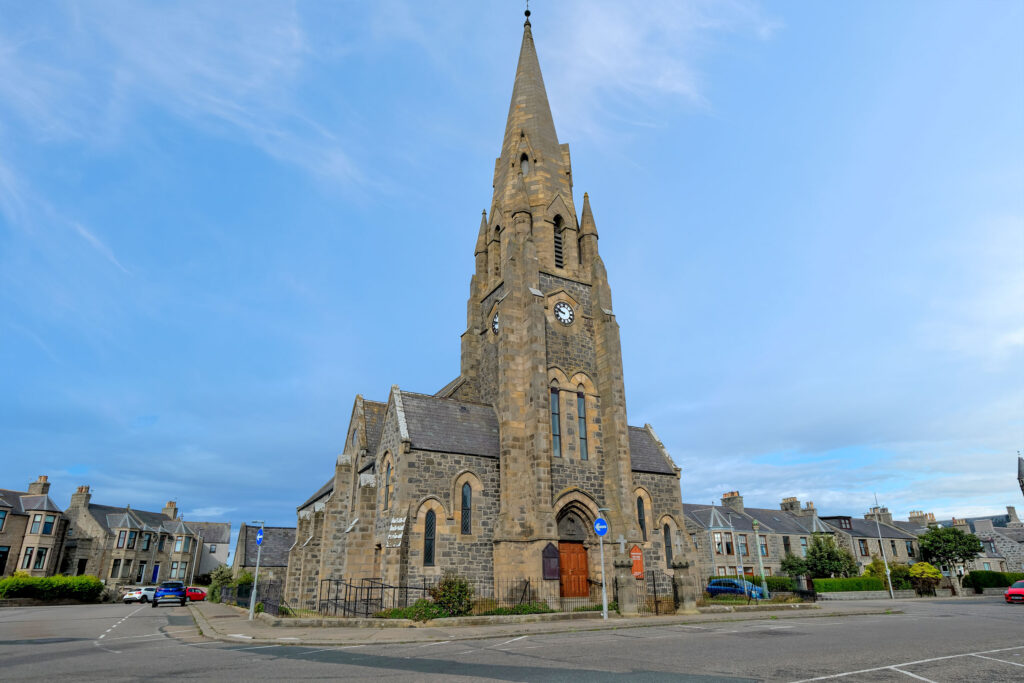
Built from local sandstone and granite, Fraserburgh West Church is an impressive example of Victorian Gothic church architecture. Standing prominently at what is locally known as The Hexagon, where several of Fraserburgh’s principal streets meet, the church has long been one of the town’s most recognisable landmarks.
When completed, the church was described as standing “among the green fields” on what was then the edge of Fraserburgh. As the town expanded around it during the late nineteenth and twentieth centuries, the church became firmly established at the heart of the local community.
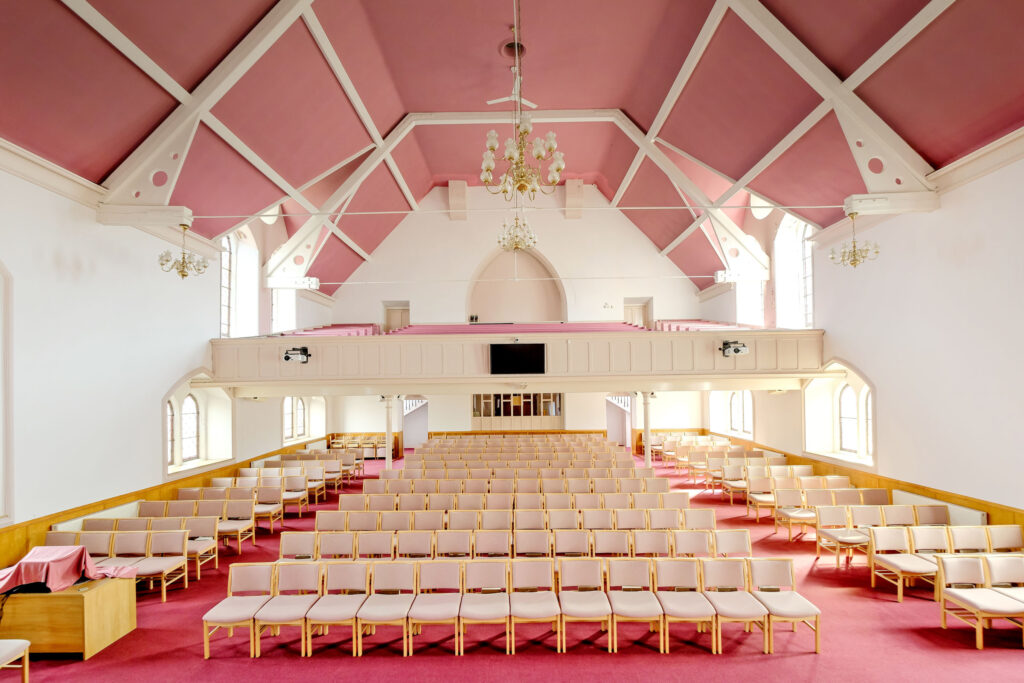
The building seats approximately 500 worshippers and has undergone sympathetic improvements over the years, including an extensive internal refurbishment completed in 2007 while carefully preserving the character of the original church.
Worship and Community Life
Throughout its history, Fraserburgh West has been known as an active and welcoming congregation.
Alongside regular Sunday worship, the church supported numerous organisations including Sunday School, the Church Guild, Boys’ Brigade, Girls’ Brigade, youth clubs, Messy Church, Noisy Tots, summer holiday clubs and fellowship groups for all ages. Many of these activities welcomed not only church members but people from across Fraserburgh, strengthening the church’s links with the wider community.
The congregation also invested heavily in facilities for community use. In 2000, the modern St Andrew’s Church Halls were completed following an extensive fundraising campaign supported by Lottery funding. The halls quickly became an important venue for church organisations, concerts, community groups, funeral teas and local events.
Partnership with Rathen West
A significant milestone came in June 2002, when Fraserburgh West entered a linked charge with neighbouring Rathen West Church.
Although separated by around four miles, the two congregations shared one ministry while continuing to worship in their own buildings. The partnership proved highly successful, allowing both churches to maintain their individual identities while working closely together in worship, outreach and mission.
Together the congregations developed a shared vision of serving both town and rural communities, strengthening relationships that would later help prepare the way for wider union across the Fraserburgh area.
Serving Fraserburgh
For generations, Fraserburgh West Church played an important role in the spiritual and social life of the town. Ministers, elders and volunteers provided pastoral care, visited homes and hospitals, supported local schools and welcomed people from every stage of life.
The congregation actively supported charitable causes, community organisations and ecumenical work through Fraserburgh Churches Together, demonstrating its commitment to serving the town beyond the church walls.
A Shared Future
In July 2024, Fraserburgh West Church became one of the seven congregations that united to form Fraserburgh & District Parish Church of Scotland, alongside Fraserburgh Old, Fraserburgh South, Rathen West, Inverallochy & Rathen East, Pitsligo and Sandhaven.
Although worship now continues as part of a united parish, Fraserburgh West’s legacy lives on through the generations who worshipped there, the organisations it nurtured and its longstanding commitment to sharing the Gospel within the community.
Its history remains an important chapter in the story of Fraserburgh & District Parish Church.
Key Dates
1875 – Construction of Fraserburgh West Church began.
September 1876 – Fraserburgh West Church officially opened, with the Rev. Thomas Rogers as its first minister.
1877 – West Church became a recognised quoad sacra parish.
2000 – St Andrew’s Church Halls were opened to provide modern facilities for church and community use.
2002 – Fraserburgh West entered a linked charge with Rathen West Church.
2007 – Major refurbishment of the church interior was completed.
July 2024 – Fraserburgh West united with six neighbouring congregations to form Fraserburgh & District Parish Church of Scotland.
Fraserburgh South Church
Fraserburgh South Church
A Landmark for the Growing South of Fraserburgh
Fraserburgh South Church was established in 1878 to serve the expanding southern districts of Fraserburgh during a period of rapid growth and prosperity. As the town’s population increased throughout the nineteenth century, the Church of Scotland recognised the need for an additional parish to meet the spiritual and pastoral needs of the growing community.
For nearly 150 years, Fraserburgh South Church has been a place of worship, fellowship and service. Its distinctive granite spire has become one of Fraserburgh’s best-known landmarks, visible from across the town and standing as a symbol of Christian witness for generations.
The Foundation of Fraserburgh South
By the 1870s, Fraserburgh’s expanding fishing industry and increasing population placed growing demands on the original parish church. To provide for the rapidly developing southern part of the town, a new parish was created and plans were drawn up for a purpose-built church.
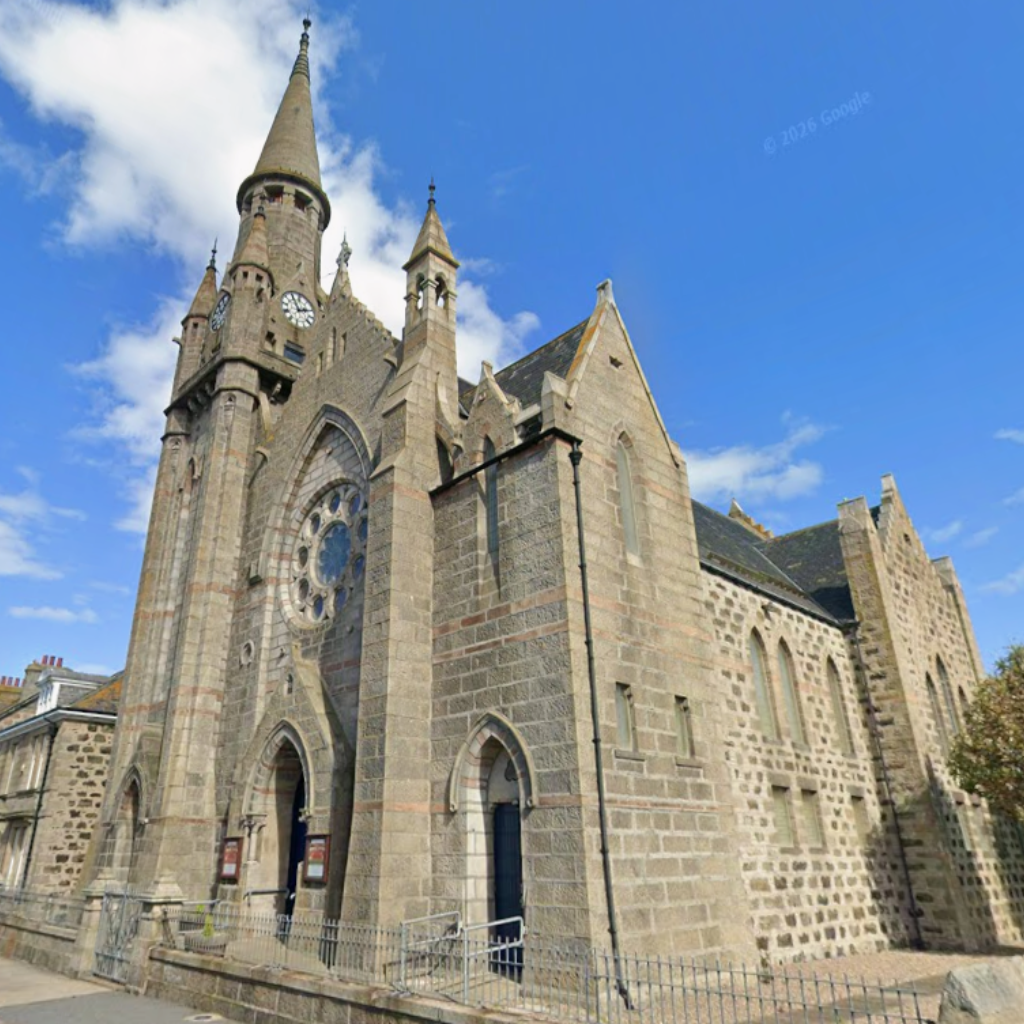
The new church was completed in 1878 and designed by the Fraserburgh architect John Bridgeford Pirie, whose work can be found throughout the north-east of Scotland. Built from locally quarried white and pink granite, the church reflected both the prosperity of the town and the confidence of Victorian church architecture.
The Church Building
Fraserburgh South Church is recognised as one of the finest Victorian churches in Aberdeenshire and is designated as a Category B Listed Building.
The building is constructed in a striking High Victorian Gothic style, combining white and pink granite with an elegant square tower rising into a slender round stone spire. Historians have variously described its design as French Gothic or German Gothic, although it is perhaps best regarded as an individual interpretation of the Gothic Revival that was popular during the late nineteenth century.
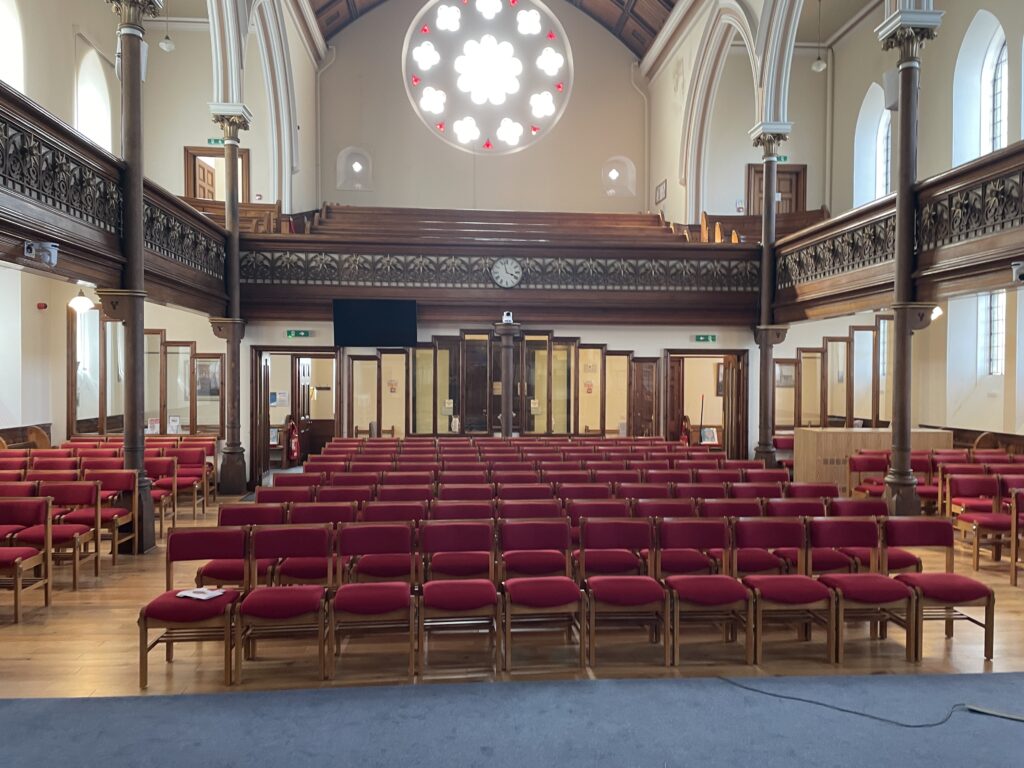
The interior is equally impressive. Much of the original craftsmanship survives, including the timber-lined walls, decorative ironwork, gallery and beautifully proportioned sanctuary. Art Nouveau influences can be seen throughout the building, particularly in the decorative sunflower motifs incorporated into the gallery front and interior detailing.
A Church at the Centre of the Community
Throughout its history, Fraserburgh South Church has been much more than simply a place of worship.
The congregation supported Sunday School, youth organisations, Bible study groups, the Church Guild, choirs and many community activities. Ministers, elders and volunteers served not only church members but the wider town through pastoral visiting, charitable work and outreach programmes.
The church building regularly hosted concerts, civic services, remembrance events and community gatherings, becoming an important meeting place for people across Fraserburgh.
The Moses Stone
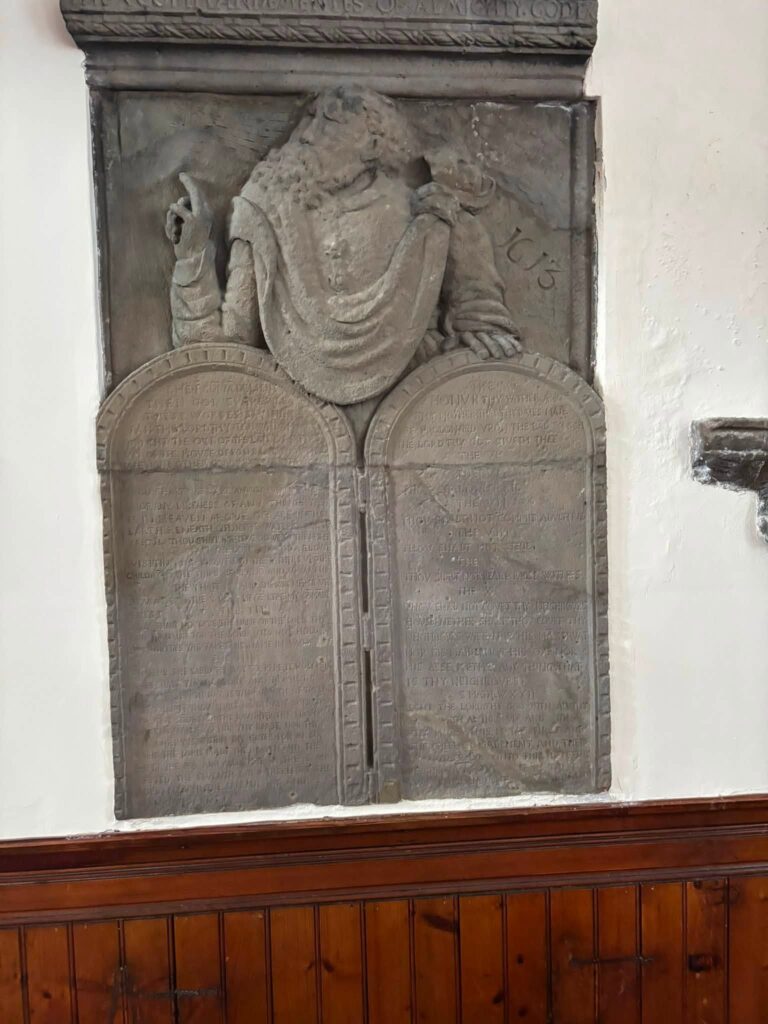
Among the church’s most unusual historical features is the Moses Stone.
The carved stone originally formed part of the University of Fraserburgh, founded in the late sixteenth century by Sir Alexander Fraser. When the university closed after only a few years, the stone survived and eventually found a permanent home within Fraserburgh South Church, preserving an important connection with one of Scotland’s earliest university foundations.
Continuing Ministry
As Fraserburgh changed during the twentieth century, Fraserburgh South Church continued to adapt while remaining committed to worship, mission and community service.
The church underwent refurbishment to improve its facilities while carefully preserving its historic character. Modern accessibility improvements ensured that the building continued to welcome worshippers and visitors alike, while maintaining its architectural significance.
Over the decades, countless baptisms, weddings, funerals and services of thanksgiving were held within its walls, making the church an important part of family life for generations of local people.
A Shared Future
In July 2024, Fraserburgh South Church became one of the seven congregations that united to form Fraserburgh & District Parish Church of Scotland, alongside Fraserburgh Old, Fraserburgh West, Rathen West, Inverallochy & Rathen East, Pitsligo and Sandhaven.
Today, the history of Fraserburgh South continues as part of the united parish. Its distinctive building, faithful congregation and long tradition of worship remain an important chapter in the shared story of Fraserburgh & District Parish Church.
Key Dates
1878 – Fraserburgh South Church was completed and opened for worship.
1878 – Designed by local architect John Bridgeford Pirie using locally quarried white and pink granite.
Late 19th Century – The Moses Stone from the former University of Fraserburgh was preserved within the church.
2007 – Internal refurbishment and modernisation works were completed while preserving the historic interior.
July 2024 – Fraserburgh South united with six neighbouring congregations to form Fraserburgh & District Parish Church of Scotland.
Pitsligo Parish Church (Rosehearty)
Pitsligo Parish Church (Rosehearty)
A Church Serving a Historic Parish
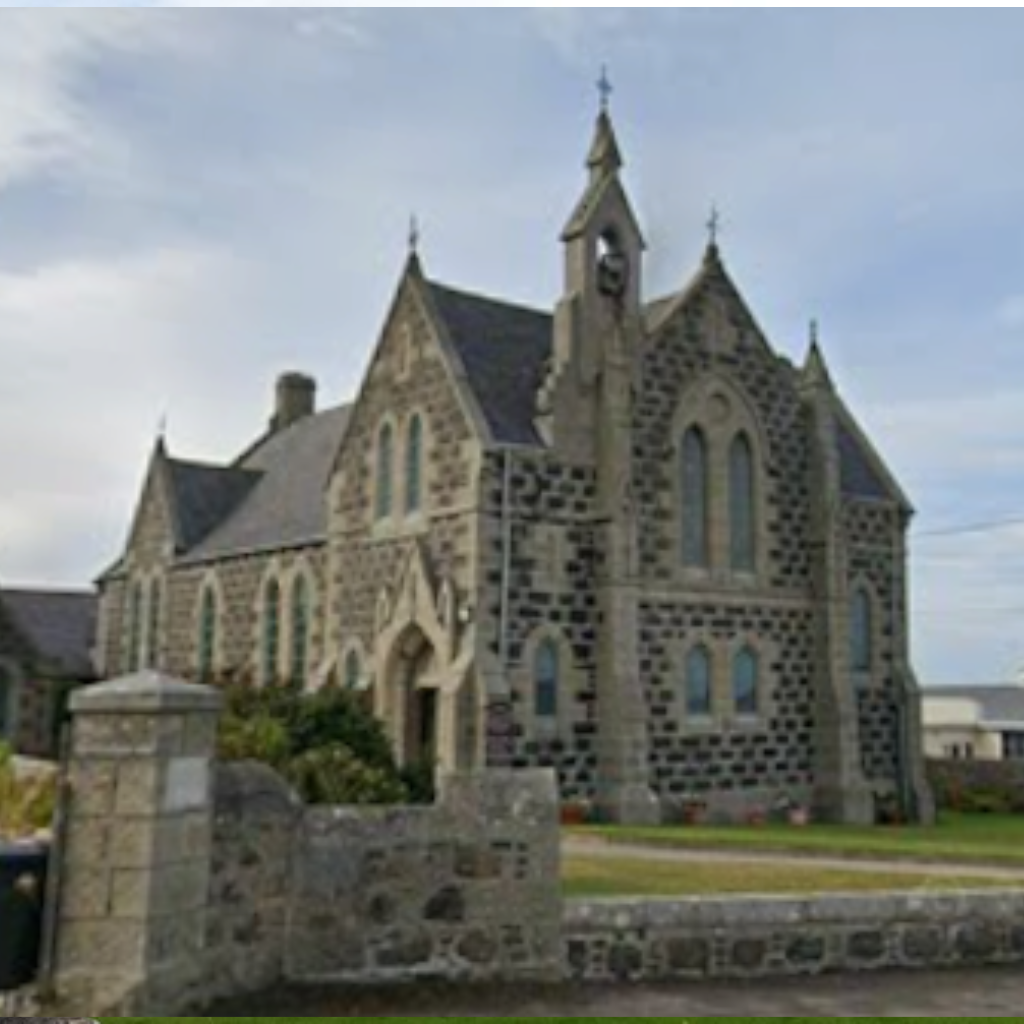
Pitsligo Parish Church has served the communities of Rosehearty, Pittulie and the surrounding area for generations. Although the present church building in Rosehearty was completed in 1882, the history of the parish stretches back much further to the establishment of the Parish of Pitsligo in 1633.
For centuries, the parish has been at the heart of community life, witnessing baptisms, weddings, funerals and weekly worship across changing generations. Today, its story forms an important chapter in the history of Fraserburgh & District Parish Church.
The Historic Parish of Pitsligo
Before the creation of the Parish of Pitsligo, the area formed part of the neighbouring Parish of Aberdour. According to local legend, the minister of Aberdour once referred in a sermon to the “three pits of Hell” — Pittulie, Pittendrum and Pitsligo, declaring Pitsligo to be the worst of them. Offended by the remark, Lord Pitsligo is said to have left the church and successfully petitioned for the creation of a separate parish.
Whether entirely fact or embellished through local folklore, the story has been passed down through generations and remains one of the best-known traditions associated with the parish’s origins.
The Parish of Pitsligo was formally created by an Act of the Scottish Parliament in 1633, having been formed from parts of the neighbouring parishes of Aberdour, Fraserburgh and Tyrie. At that time, Sandhaven did not yet exist, and Pittulie was the principal settlement within the parish alongside Rosehearty.
A church had already been built at Peathill around 1630, becoming the first parish church and serving the newly established parish for more than 250 years. The parish’s first minister was Andrew Cant, one of Scotland’s best-known Covenanting ministers and a leading figure in the Covenanter movement.
Known locally as Peathill Kirk or the Visible Kirk, the original church stood on high ground overlooking the coast and became a familiar landmark for local fishermen returning from the Moray Firth. Its distinctive bellcote remains one of the finest surviving examples of seventeenth-century church architecture in north-east Scotland.
Three Congregations in Rosehearty
By the nineteenth century, divisions within Scottish Presbyterianism had resulted in three separate congregations serving the village of Rosehearty.
The original Church of Scotland congregation continued to worship at Peathill Kirk. Following the Disruption of 1843, a Free Church of Scotland congregation was established in Loch Street, while the United Presbyterian (Secession) Church first worshipped in Union Street before constructing the present church in Pitsligo Street in 1882.
In 1906, the Free Church and the United Presbyterian Church united, with the congregation worshipping in the present Pitsligo Street church.
Following the national reunion of the Church of Scotland and the United Free Church in 1929, two Church of Scotland congregations once again existed within the Parish of Pitsligo. These were finally brought together in 1954, when the congregations united to form a single parish church, worshipping in the present Rosehearty building.
The Present Church
Constructed from locally quarried dark granite with contrasting ashlar dressings, the church reflects the confidence and prosperity of the expanding fishing community during the late Victorian period.
Its simple Gothic design, with its tall central gable, bellcote and spacious interior, continues to make it one of Rosehearty’s most recognisable buildings.
Although regular worship transferred to the Rosehearty church following the union of the congregations in 1954, the historic church at Peathill remained in occasional use for many years before regular worship finally ceased there in 1997.
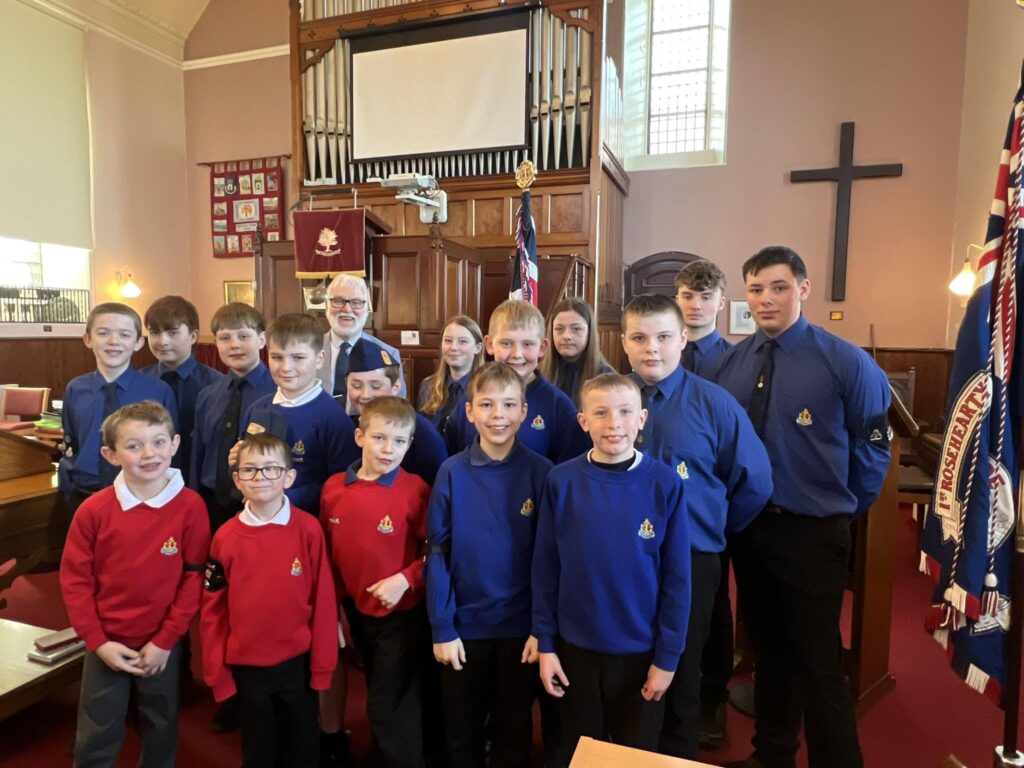
Worship and Community Life
Throughout its history, Pitsligo Parish Church has been at the centre of village life.
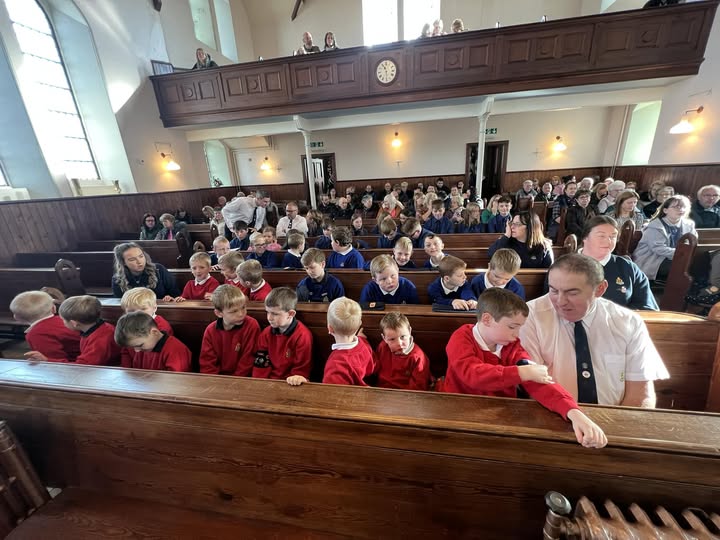
The congregation has supported regular worship, Sunday School, youth organisations, the Church Guild and a wide range of community activities. Generations of ministers, elders and volunteers have provided pastoral care throughout the parish, serving families in Rosehearty, Pittulie, Sandhaven and the surrounding communities.
The church has also hosted concerts, remembrance services, seasonal celebrations and community events, strengthening its role as both a place of worship and a gathering place for the wider community.
Working Together
As populations changed and congregations became smaller, Pitsligo Parish Church increasingly worked alongside neighbouring churches. It was linked with Sandhaven Parish Church in 1985, sharing ministry while continuing to serve both communities.
These partnerships reflected the changing needs of the Church of Scotland while maintaining a faithful Christian presence across the west of the Fraserburgh area.
A Shared Future
In July 2024, Pitsligo Parish Church became one of the seven congregations that united to form Fraserburgh & District Parish Church of Scotland, alongside Fraserburgh Old, Fraserburgh South, Fraserburgh West, Rathen West, Sandhaven and Inverallochy & Rathen East.
Today, the congregation’s rich heritage continues within the united parish. From the creation of the Parish of Pitsligo in 1633, through centuries of worship at Peathill and later in Rosehearty, its history remains an enduring part of the Christian witness across Buchan.
Key Dates
c.1630 – The original parish church was built at Peathill.
1633 – The Parish of Pitsligo was established by Act of the Scottish Parliament, with Andrew Cant becoming its first minister.
1843 – A Free Church congregation was established in Rosehearty following the Disruption.
1882 – The present church in Pitsligo Street was built for the United Presbyterian Church.
1906 – The Free Church and United Presbyterian congregations united, worshipping in the present church.
1929 – The Church of Scotland and United Free Church reunited nationally, leaving two Church of Scotland congregations within the parish.
1954 – The two Church of Scotland congregations united, with worship continuing in the present Rosehearty church.
1985 – Pitsligo entered a linked charge with Sandhaven Parish Church.
1997 – Regular worship ceased at the historic Peathill Kirk.
July 2024 – Pitsligo Parish Church united with six neighbouring congregations to form Fraserburgh & District Parish Church of Scotland.
Sandhaven Parish Church
Sandhaven Parish Church
A Church at the Heart of a Coastal Community
Sandhaven Parish Church served the coastal village of Sandhaven and its surrounding community for well over a century. Founded as an Established Mission Church in 1882, it was created to bring regular Church of Scotland worship to the growing fishing village, providing a local place of worship for families who had previously travelled to neighbouring parishes.
For more than 140 years, the church stood at the centre of village life, witnessing baptisms, weddings, funerals and weekly worship while serving generations of local families. Though modest in size, Sandhaven Church became an important part of the community’s identity and Christian witness.
The Foundation of Sandhaven Church
During the late nineteenth century, Sandhaven was developing into a busy fishing village with an increasing population. Recognising the need for a local Church of Scotland presence, an Established Mission Church was built in 1882.
The new church provided a permanent home for worship and pastoral ministry within the village, allowing local residents to gather together without travelling to neighbouring churches. It quickly became a focal point for both spiritual life and community activity.
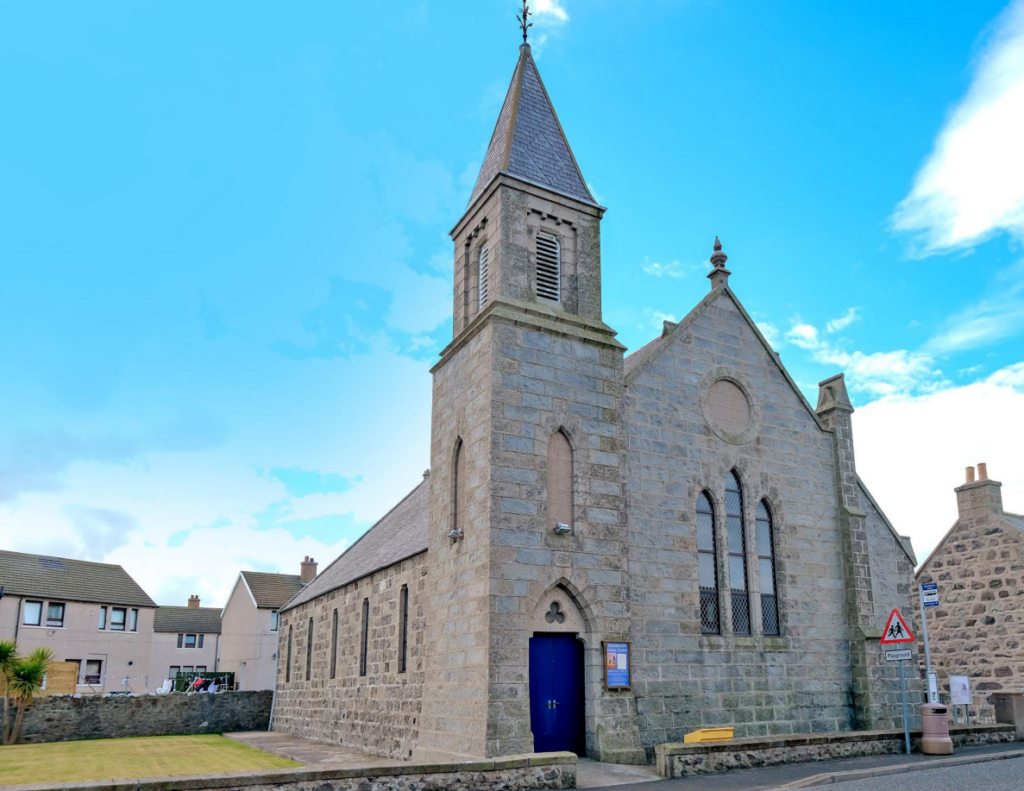
The Church Building
Situated on High Street, just a short walk from Sandhaven’s picturesque harbour and beach, the church occupied a prominent position within the village.
The building was designed as a simple and welcoming place of worship, reflecting the character of the fishing community it served. While not grand in scale, its straightforward design and warm atmosphere made it a familiar landmark for generations of villagers.
Over the years, the building continued to adapt to meet the needs of the congregation while retaining its role as an important community space.
Worship and Village Life
Throughout its history, Sandhaven Parish Church played a central role in village life.
Regular Sunday worship was complemented by Sunday School, harvest thanksgiving services, Christmas celebrations, community gatherings and pastoral care for local families. Ministers, elders and volunteers faithfully served the congregation, supporting people through both joyful occasions and times of loss.
The church maintained close links with local organisations and neighbouring congregations, helping to foster a strong sense of community within the village.
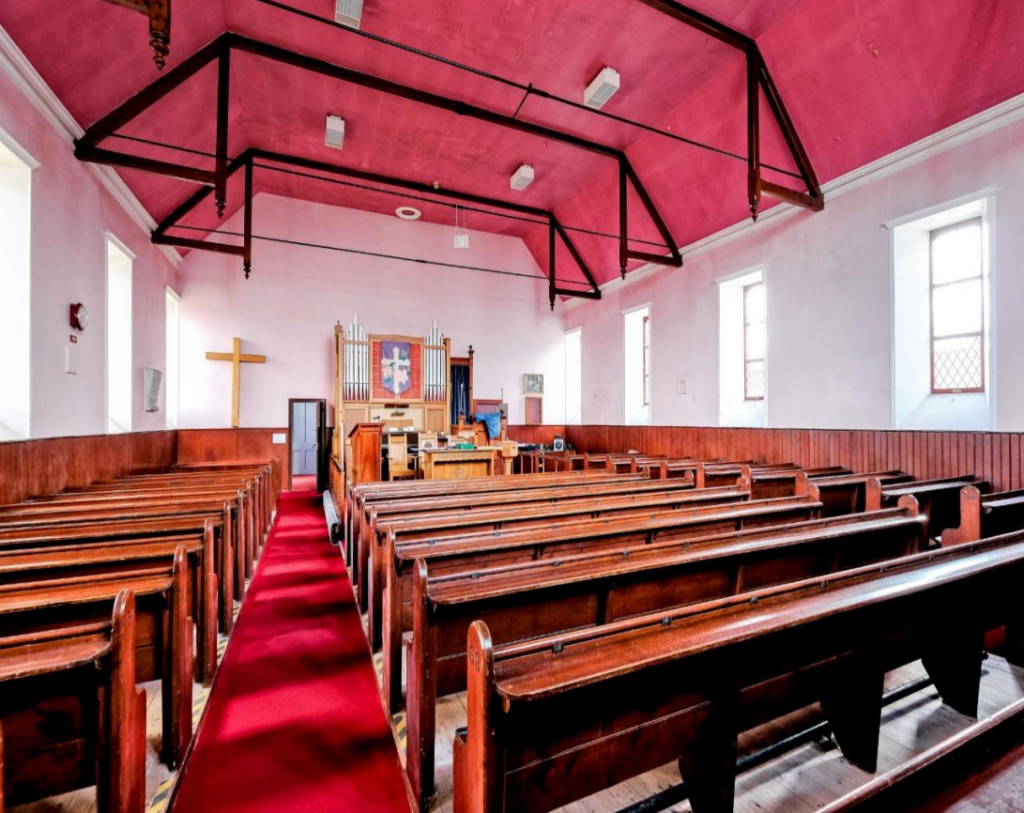
Partnership with Pitsligo
As patterns of church life changed during the late twentieth century, Sandhaven Parish Church began working more closely with neighbouring congregations.
In 1985, Sandhaven entered a linked charge with Pitsligo Parish Church (Rosehearty), sharing ministry while continuing to worship in its own building. This partnership strengthened relationships between the two congregations and ensured that a Church of Scotland presence continued across the west of the Fraserburgh area.
The link reflected the wider changes taking place throughout the Church of Scotland as congregations adapted to changing populations and patterns of ministry.
A Shared Future
In July 2024, Sandhaven Parish Church became one of the seven congregations that united to form Fraserburgh & District Parish Church of Scotland, alongside Fraserburgh Old, Fraserburgh South, Fraserburgh West, Rathen West, Pitsligo and Inverallochy & Rathen East.
Following the union, the charity governing Sandhaven Parish Church was dissolved as its work continued within the new united congregation. Although regular worship as a separate parish came to an end, the church’s legacy remains an important part of the shared history of Fraserburgh & District Parish Church.
Key Dates
1882 – Sandhaven Established Mission Church was founded to serve the growing fishing village.
1935 – Sandhaven Parish Church was formally registered as a charity.
1985 – Sandhaven entered a linked charge with Pitsligo Parish Church.
2 July 2024 – Sandhaven Parish Church united with six neighbouring congregations to form Fraserburgh & District Parish Church of Scotland, and its separate charity ceased following the union.
Inverallochy & Rathen East Parish Church
Inverallochy & Rathen East Parish Church
A Church Formed Through Unity
Inverallochy & Rathen East Parish Church was formed in 1930 through the union of two neighbouring congregations, but its story reaches back to the early nineteenth century. The united congregation inherited the traditions of Inverallochy Parish Church, established as a Chapel of Ease in 1842, and Rathen East Free Church, whose congregation was formed following the Disruption of 1843.
For almost a century, these two congregations worshipped separately while serving many of the same communities. Their eventual union reflected the wider reunification of Scottish Presbyterianism and created a congregation that continued to serve Inverallochy, Cairnbulg, Rathen and the surrounding district for generations.
Inverallochy Parish Church
The story of Inverallochy Parish Church began with the rapid growth of the fishing communities of Inverallochy and Cairnbulg during the early nineteenth century. To provide a more convenient place of worship than the ancient parish church at Rathen, a new Chapel of Ease was built through public subscription, together with assistance from the General Assembly’s Church Extension Fund.
The church was opened on 9 October 1842 as a Chapel of Ease Mission Station connected to Rathen West Parish Church, often known as the “Mither Kirk”. The first minister was the Rev. Alexander Cobban.
Only a few months after the church opened, Scotland experienced the Disruption of 1843. Rev. Cobban and the majority of the congregation left the established Church of Scotland to join the newly formed Free Church of Scotland. Between 1843 and 1848, services in the Church of Scotland chapel were conducted by the Rev. Cock of Rathen West until the appointment of the Rev. Ogg.
In April 1864, Inverallochy was erected into a quoad sacra parish of the Church of Scotland, giving the congregation its own Kirk Session and minister. The Rev. Ogg, who had served the congregation since 1848, became the first minister of the new parish.
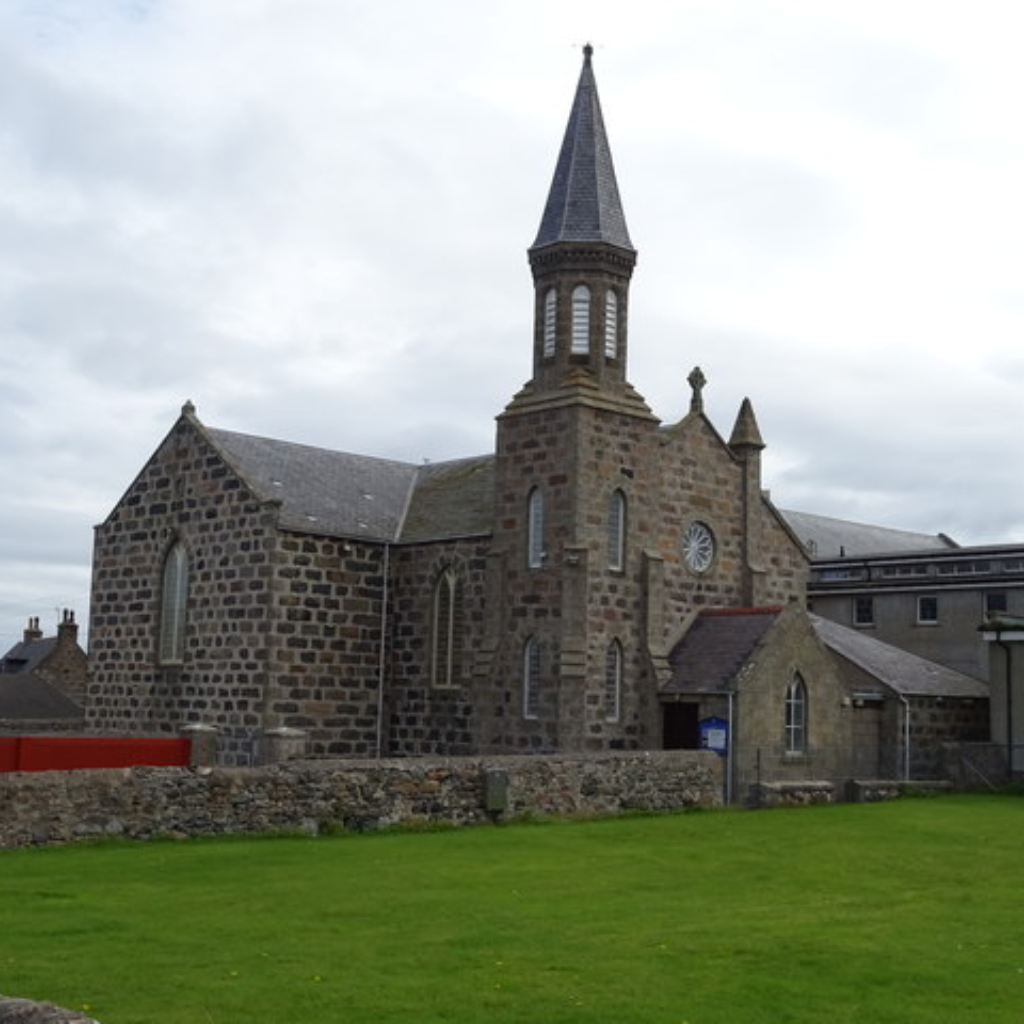
The church building itself evolved over the years. Originally built in a distinctive T-shaped plan with the pulpit on the north wall, it underwent a major renovation in 1882. The interior was completely renewed, a gallery supported by fluted Roman Doric columns was installed, a vestry was added, and a 75-foot steeple was erected, giving the church much of its present appearance. Around 1935 a porch was added, and in 1993 the building underwent another extensive refurbishment under the ministry of the Rev. Ronnie Yule.
Rathen East Free Church
The second strand of the congregation’s history began with the Disruption of 1843, when many ministers and congregations left the established Church of Scotland to form the Free Church of Scotland.
A Free Church congregation was established to serve the eastern part of the Parish of Rathen. Although the congregation began in 1843, its church building was not completed until 1847–48. For the next eighty years, worship continued there under the Free Church and later the United Free Church of Scotland.
The church was renovated around 1896 and was served by four ministers before the reunion of Scottish Presbyterian churches led to its incorporation into the Church of Scotland. The Rathen East Manse, built around the same period as the church, became the preferred residence for ministers serving the united charge.
The Union of 1930
In 1929, the Church of Scotland and the United Free Church of Scotland were reunited after almost ninety years of separation. Across Scotland, many neighbouring congregations were brought together as part of this historic reunion.
On 9 October 1930, exactly eighty-eight years after the opening of Inverallochy Church, the Rev. John Turner preached the first service of the newly formed united charge of Inverallochy & Rathen East Parish Church.
Both church buildings initially continued in use, preserving the traditions and identities of each former congregation while creating a single parish to serve the surrounding communities.
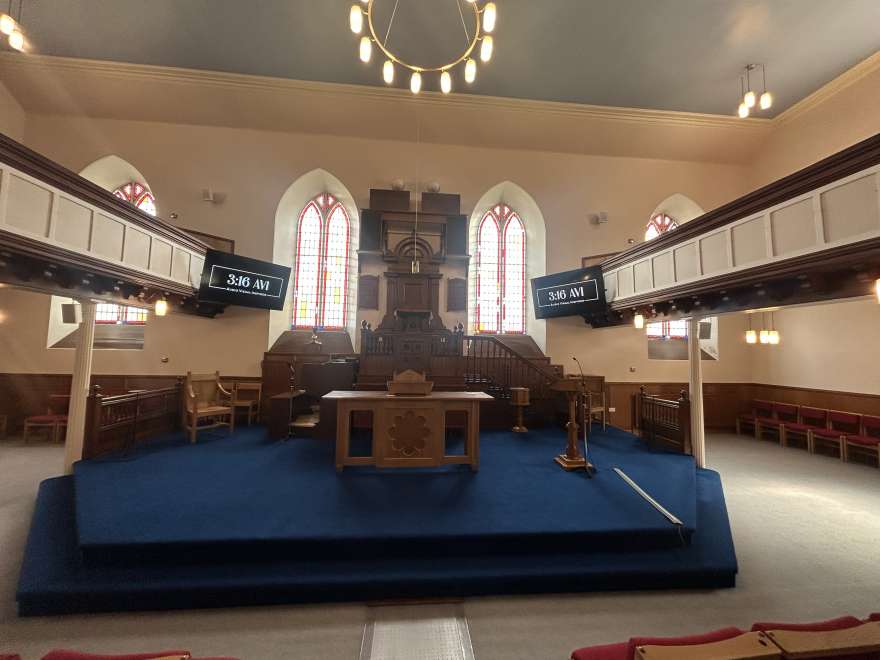
Worship and Community Life
Throughout its history, Inverallochy & Rathen East Parish Church played an important role in the spiritual and community life of the villages it served.
Regular Sunday worship, baptisms, weddings, funerals, harvest thanksgiving services, remembrance observances, Sunday School, youth organisations and seasonal celebrations formed the rhythm of congregational life. Ministers, elders and volunteers provided pastoral care and Christian witness across generations, making the church an important part of village life.
The church building became a familiar landmark overlooking the village and remained a place where faith, friendship and community came together.
Partnership with Fraserburgh South
As patterns of church life changed during the late twentieth century, Inverallochy & Rathen East entered a linked charge with Fraserburgh South Parish Church.
The linking service took place on 11 December 1983 under the ministry of the Rev. Ronnie Yule. At that time, Rathen East Church closed for regular worship, while ministry continued through the linked charge centred on Inverallochy and Fraserburgh South.
The partnership strengthened relationships between neighbouring congregations and laid important foundations for the wider union that would follow decades later.
A Shared Future
In July 2024, Inverallochy & Rathen East Parish Church became one of the seven congregations that united to form Fraserburgh & District Parish Church of Scotland, alongside Fraserburgh Old, Fraserburgh South, Fraserburgh West, Rathen West, Pitsligo and Sandhaven.
Today, the history of Inverallochy & Rathen East lives on within the united parish. From the Chapel of Ease established in 1842, through the Disruption, the reunion of 1930 and the linked charge with Fraserburgh South, the congregation’s story reflects nearly two centuries of Christian faith, service and community life in the villages of Inverallochy, Cairnbulg and Rathen.
Key Dates
9 October 1842 – Inverallochy Chapel of Ease opened to serve the communities of Inverallochy and Cairnbulg.
1843 – The Disruption; Rev. Alexander Cobban and much of the congregation joined the Free Church of Scotland.
1847–48 – Rathen East Free Church building completed.
1848 – Rev. Ogg became preacher at Inverallochy Chapel of Ease.
April 1864 – Inverallochy became a quoad sacra parish of the Church of Scotland.
1882 – Inverallochy Church extensively renovated and enlarged.
1929 – The Church of Scotland and United Free Church reunited.
9 October 1930 – Inverallochy and Rathen East united to form Inverallochy & Rathen East Parish Church.
Around 1935 – Porch added to Inverallochy Church.
11 December 1983 – Linked charge with Fraserburgh South established; Rathen East Church closed for regular worship.
1993 – Major renovation of Inverallochy Church under the Rev. Ronnie Yule.
July 2024 – Inverallochy & Rathen East became part of Fraserburgh & District Parish Church of Scotland.
Fraserburgh & District Parish Church
Fraserburgh & District Parish Church
A New Chapter Built on Centuries of Faith
Fraserburgh & District Parish Church was formed in July 2024, bringing together seven congregations with a shared commitment to worship, mission and serving their communities.
The union brought together:
- Fraserburgh Old Parish Church
- Fraserburgh South Church
- Fraserburgh West Church
- Rathen West Church
- Inverallochy & Rathen East Parish Church
- Pitsligo Parish Church
- Sandhaven Parish Church
While the parish itself is new, its story spans more than 450 years, beginning with the foundation of Fraserburgh Old Parish Church in 1571 and continuing through generations of faithful Christian witness across Fraserburgh and the surrounding villages.
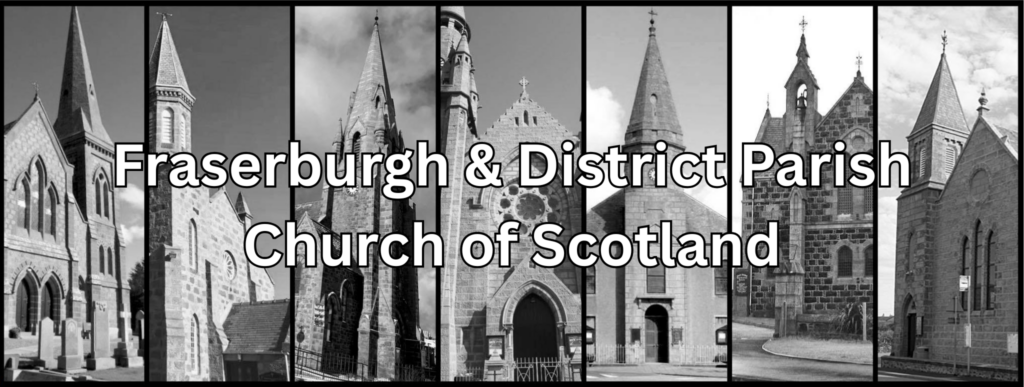
Coming Together as One Parish
For many years, the Church of Scotland has sought new ways to respond to changing populations, patterns of worship and the need to use resources wisely. Across Scotland, neighbouring congregations have increasingly worked together through linked charges, shared ministries and parish unions.
Within the Fraserburgh area, several congregations had already developed close relationships through shared ministry and mission. Fraserburgh West and Rathen West had worked together since 2002, while Fraserburgh South shared ministry with Inverallochy & Rathen East. Pitsligo and Sandhaven had also enjoyed many years of partnership.
Building on these relationships, the Presbytery approved the formation of a single united congregation serving Fraserburgh and the surrounding communities.
The Union of 2024
The legal union of the seven congregations took effect in July 2024, creating Fraserburgh & District Parish Church of Scotland. The congregation inherited the charitable status of the former Fraserburgh Old Church, which was renamed Fraserburgh & District Parish Church, while the remaining parish charities were dissolved as they became part of the united congregation.
A special Service of Union was held on 28 July 2024, led by the Presbytery of the North East and the Northern Isles. This marked the beginning of a new chapter in the life of the Church across Fraserburgh and the surrounding villages, celebrating both the heritage of the former congregations and a shared vision for the future.
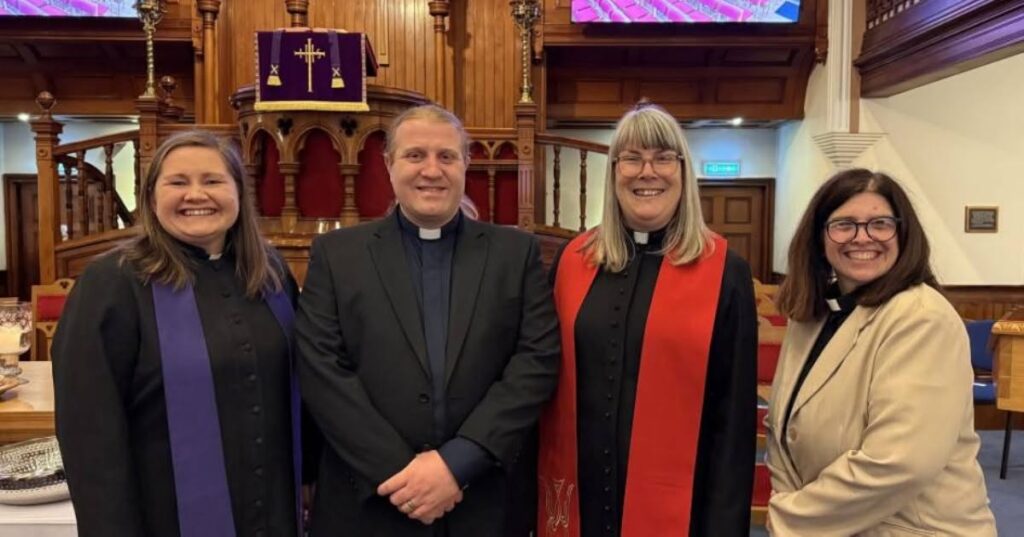
Worship and Mission Today
Today, Fraserburgh & District Parish Church serves a large parish stretching from the town of Fraserburgh to the coastal communities of Inverallochy, Cairnbulg, Rosehearty, Sandhaven and Rathen, together with the surrounding rural areas.
The parish seeks to continue the work begun by earlier generations by:
- Gathering people together in worship.
- Sharing the good news of Jesus Christ.
- Supporting people of all ages through pastoral care.
- Serving local communities with compassion and hospitality.
- Working alongside schools, charities and community organisations.
- Preserving and celebrating the rich Christian heritage of the parish.
Although the church now worships as one congregation, the history, traditions and identity of each former church remain an important part of the life and story of the united parish.
Honouring Our Heritage
Each of the seven former congregations contributed something unique to the life of the Church.
From the sixteenth-century foundation of Fraserburgh Old, to the Victorian expansion that saw new churches established across the district, to the faithful ministry of village congregations serving coastal and rural communities, every church has helped shape the story of Christianity in this part of Buchan.
This Heritage section has been created to preserve those stories, ensuring that the faith, service and dedication of previous generations continue to inspire those who worship here today.
Looking Forward
The formation of Fraserburgh & District Parish Church represents not the end of seven stories, but the beginning of a new one.
Built upon centuries of faith, worship and service, the united parish continues to proclaim the Gospel of Jesus Christ while serving the people of Fraserburgh and the surrounding communities. As one congregation, we look to the future with confidence, seeking to build on the foundations laid by those who have gone before us and to share God’s love with future generations.
Key Dates
1571 – Fraserburgh Old Parish Church was founded, marking the earliest roots of today’s parish.
1870–1882 – New churches were established across the district as communities expanded.
1930 – Inverallochy and Rathen East united to form a single charge.
2 July 2024 – The union of the seven congregations took legal effect, creating Fraserburgh & District Parish Church.
28 July 2024 – The Presbytery Service of Union celebrated the beginning of the new united parish.